Software factory
What is a software factory?
How AI coding agents turn tickets into shipped code, where the idea came from, and the part most factories still skip: finding out whether the change did anything for the people using the site.
What does software factory mean today?
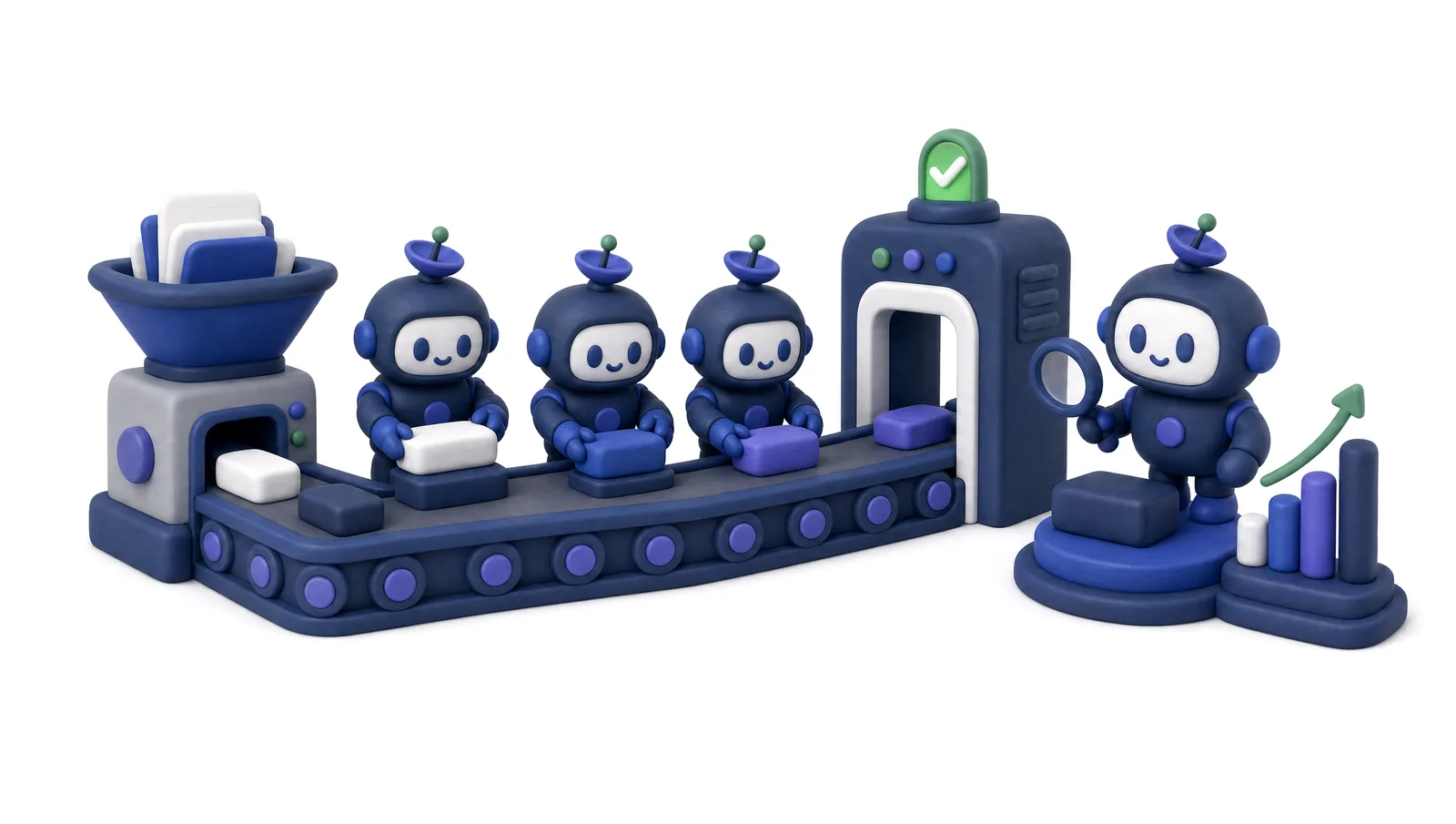
A software factory is a setup where coding agents take a spec or a ticket and carry it through to merged, deployed code, with many agents working in parallel. People decide what should be built and guard the gates where judgment matters, like review and release, and the agents do most of the typing in between.
The phrase is older than AI. It has meant Japanese software houses in the 1970s, a Microsoft method in 2004 and US military DevSecOps teams, so search results mix all of these together.
History
Where the term comes from
Each version borrows its picture from manufacturing, with a standard process, reusable parts and output someone can count. The newest one mostly changes who is doing the work.
Late 1960s
General Electric and Hitachi
Robert Bemer wrote about a software factory at General Electric in the late 1960s, and Hitachi opened its Software Works in 1969. Both dates come from Factory's own explainer, which cites the IEEE Computer Society's record.
1991
Japan's software factories
Michael Cusumano of MIT published Japan's Software Factories: A Challenge to U.S. Management, a book about the large Japanese software houses that used the word for how they organised their programmers.
Cusumano, Japan's Software Factories (Oxford University Press, 1991)
2004
Microsoft Software Factories
Jack Greenfield at Microsoft defined it as "a development environment configured to support the rapid development of a specific type of application": patterns, models and tools assembled for one kind of product.
Greenfield, The Case for Software Factories (Microsoft, July 2004)
2017 onward
US military software factories
In the US defence world a software factory is an in-house DevSecOps team that ships quickly. Bryon Kroger, now CEO of Rise8, writes that he "co-founded Kessel Run, the Department of War's (DoW) first software factory".
2026
Factories run by coding agents
The current meaning keeps the production line and hands most of the work to agents. StrongDM's team went as far as ruling that no human writes or reviews the code.
Who says it now
The people building agent factories
Since early 2026 the phrase has mostly meant agents. These are the people and companies using it, in their own words.
StrongDM
“Code must not be written by humans. Code must not be reviewed by humans.”
The founding rules of StrongDM's AI team. They test with "scenarios", end-to-end user stories kept outside the codebase so the agents can't see them, a bit like a holdout set in model training.
Dan Shapiro
“It's a black box that turns specs into software.”
His description of level five, the dark factory, in a five-level scale that starts at autocomplete. He adds that it's dark "because it's a place where humans are neither needed nor welcome."
Cursor
“It is about helping developers build the factory that creates their software.”
Michael Truell calls this the third era of AI coding. He says 35% of the pull requests Cursor merges internally are now created by agents running on their own in cloud machines.
Addy Osmani
“Verification, not generation, is the real constraint on a factory.”
He describes a factory as many agent loops running at once, fed by a queue of work and drained through a review gate into production. A dark factory, in his words, "runs with the lights physically off", and a lit one keeps people where judgment is needed.
Addy Osmani, Software Factories, Light and Dark, July 20, 2026
Factory
“This system is the software factory.”
Factory, the company behind the Droid coding agents, calls the whole system "a continuous feedback loop", where monitoring the deployed software produces the signals for the next round of work.
How it works
The stages of a software factory
Different teams draw it differently, but most descriptions share the same stations. Here they are in order, pieced together from the posts quoted on this page.
- 01
Intake
Tickets, bug reports and feedback turn into a written spec. Agents can't ask about requirements nobody wrote down.
- 02
Plan
An agent reads the codebase and breaks the spec into tasks small enough to hand out.
- 03
Build
Several agents work in parallel, each on its own task, branch and context.
- 04
Checks
Tests, type checks, linting and CI run on every change before anyone looks at it.
- 05
Scenarios
End-to-end user stories, sometimes hidden from the builders, test whether the feature does what a user needs.
- 06
Review
Review agents go first, then a person, unless the factory is fully dark.
- 07
Merge
The change lands on the main branch. Most factory write-ups stop here.
- 08
Deploy
The change goes live, often behind a flag so it can be turned off.
- 09
Outcome
Growth RadarSomeone checks whether the change made a difference to real visitors, and what they learn becomes the next ticket.
In most diagrams the line bends back on itself, so the outcome of one change shapes what gets built next.
The gap
Most factories stop at the merge
Read the factory write-ups closely and most of them end at the same place: the tests are green, the pull request merged and maybe it deployed. Whether the change helped anyone is left for later, if it comes up at all.
Almost no one
Factory itself says the loop from production back to the next piece of work is mostly still open: "Almost no one has meaningfully instrumented this loop to be fully AI-driven."
Faster, less stable
Google's DORA 2025 report found AI adoption goes with higher delivery throughput, yet it "does continue to have a negative relationship with software delivery stability." Its summary: AI amplifies whatever a team already is.
+44% code, +13.7% issues
Two Harvard researchers, Fiona Chen and James Stratton, studied Jellyfish engineering data from 655 firms. A year after firms added AI agents on top of their coding assistants, lines of code rose a further 44% and pull requests 35.7%, while resolved Jira issues rose 13.7%, a borderline significant result. In their words, "Code review becomes the bottleneck."
Chen and Stratton, Artificial Intelligence in the Firm (working paper, version of November 19, 2026)
Feature-flag and experiment tools do cover part of this for product metrics, on code a team wraps in a flag or a test. None of the factory posts quoted here go further than that and tie a shipped change back to how people find the site in search and AI answers, whether they sign up, and whether revenue moved.
Where Growth Radar fits
The outcome stage for a factory that builds websites
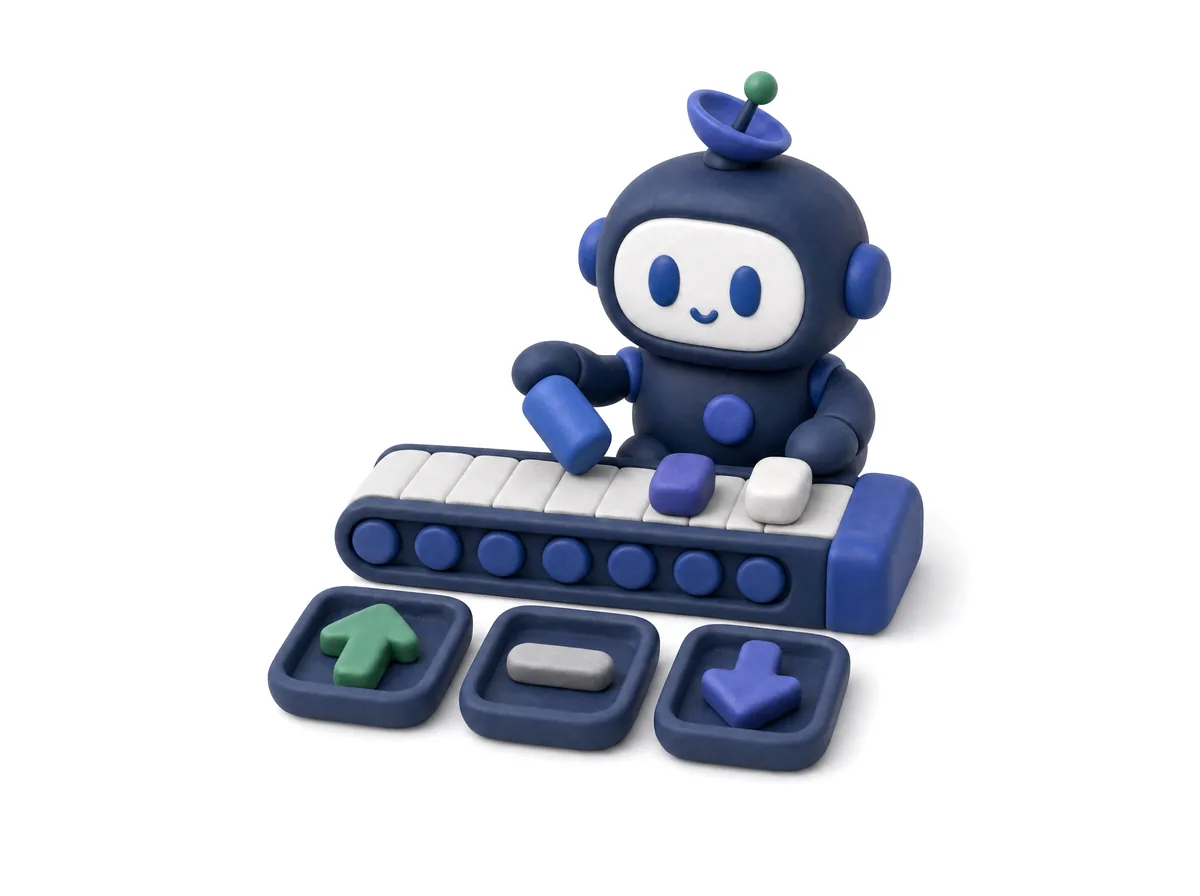
Growth Radar works as the last station of a factory that builds websites. It doesn't write any code itself. Its job is to tell your agents what's worth working on next for each site, and then, once a change has shipped, whether it actually helped.
The whole path, from your own accounts
For each site it reads search, AI answers, visitors, engagement and return visits, signups and revenue, errors and speed, from your own accounts.
Work for the intake
It ranks what's worth fixing on each site and hands the work to your coding agent over MCP or the command line, with steps and a way to check the fix.
A check that it went live
When your agent says a change shipped, Growth Radar checks the live site to confirm it's really there before it starts counting.
A verdict a few weeks later
Once enough time has passed, it compares the changed pages with similar pages nobody touched and tells you whether the change helped, did nothing or hurt.
A track record for each agent
Each change an agent ships is credited to that agent, so you can see how each one's changes turned out in the app, and agents can read the same record.
A watch on the whole site over months
Single changes aren't the whole story, so it also tracks each site's visits, search clicks, return visits and revenue over the last twelve weeks against its own normal. When one starts falling and nothing on the list deals with it, it opens a job to find the cause and moves related work up.
It works with Claude Code, Cursor, Codex, Factory's Droid and any other agent that speaks MCP, and there is a command-line tool for agents that prefer a shell.
Risks
What can go wrong
The people who run these setups are fairly open about where they hurt, and the problems they describe are worth knowing before you build one.
Review becomes the bottleneck
When agents write more code, people end up spending their time checking it. OpenAI's team building with Codex put it plainly: "As code throughput increased, our bottleneck became human QA capacity."
Ryan Lopopolo, OpenAI, Harness engineering, February 11, 2026
It costs real money
StrongDM says a team that hasn't spent at least $1,000 on tokens per engineer per day has room to improve. Simon Willison's reply was that if these patterns add $20,000 a month per engineer, "they're far less interesting to me."
More issues get through
CodeRabbit looked at 470 open-source pull requests and found 10.83 issues per AI-assisted pull request against 6.45 for human ones, with security issues up to 2.74 times higher. Authorship was inferred from co-author signals, so read it as a rough guide.
Agents grading agents
Eran Kahana at Stanford CodeX points out that in a dark factory "the same class of technology that writes the code also decides whether the code works", which leaves open who is responsible when it fails.
Questions about software factories
What is a software factory?
Today it usually means a setup where AI coding agents take specs or tickets and carry them through to merged, deployed code, with several agents working at once. People decide what to build and guard review and release. Older meanings include the Japanese software houses of the 1970s and 80s, Microsoft's 2004 method and US military DevSecOps teams.
Is a software factory the same as a dark factory?
A dark factory is the most extreme version, where no person writes or reads the code. The name comes from lights-out manufacturing plants that run with only machines on the floor. Most teams run a lit factory instead, where agents do the building and people keep the review and release decisions.
What's the hardest part of running one?
For most teams it's checking the work. Several people building these setups say verification limits them far more than code generation does, and a study of hundreds of companies using AI coding tools found code review turning into the bottleneck as the amount of code grew.
How do you know whether a factory's output helped?
Tests and review tell you the code works. To learn whether it helped, you have to watch what real visitors did after the change shipped and compare it with pages or features that didn't change, over long enough to rule out normal ups and downs.
Is grading each change enough to grow a site?
No. A site can collect a run of changes that each did fine and still slide, because of a search update, a channel drying up or a launch wearing off. That's why Growth Radar also watches each site's traffic, search, return visits and revenue week by week, and turns a real decline into work for your agent, while ignoring one-off spikes and samples too small to read.
Do I need a software factory to use Growth Radar?
No. Growth Radar works with a single coding agent, or with no agent at all if you'd rather make the changes yourself. A factory just makes the last step more useful, because more changes ship and each one gets its own verdict.
Which coding agents does Growth Radar work with?
Any agent that supports MCP, including Claude Code, Cursor, Codex and Factory's Droid. There is also a command-line tool for agents that work from a shell.
Give your factory an outcome stage
Try every Pro feature on up to 30 sites for 14 days, no card needed.